



Teaching teens and young adults about money is less about formal instruction and more about repeated exposure to real trade-offs. Financial literacy develops when young people are allowed to make choices, experience outcomes, and reflect on what happened.
Parents—and increasingly, grandparents who play an active role in their grandchildren’s lives—are often surprised to learn that the most durable money lessons do not come from lectures, apps, or classroom instruction. They come from everyday decisions involving spending, saving, and investing.
With April being National Financial Literacy Month, we thought it was appropriate to go beyond the important basics. We want to explore practical, experience-based ways parents can begin teaching teens financial literacy and the fundamentals of financial well-being. The emphasis here is on structure, boundaries, and consistency rather than control. The objective is not to eliminate mistakes, but to allow learning in a lower-stakes environment while parents can remain as a backstop.
Why Financial Literacy for Young Adults Needs to Start With Behavior, Not Theory
Financial literacy is most effectively absorbed when it is linked to behavior. Why? Because money decisions are both emotional and analytical. Teens can often explain what a budget, an investment, or interest is long before they understand how it feels to choose between competing priorities or live with the outcome of a decision.
Behavior-based learning connects money to values, trade-offs, and consequences. When teens make real decisions with real limits, abstract concepts like opportunity cost, delayed gratification, and risk tolerance become tangible.
This approach also respects the intelligence of young people by engaging them as decision-makers, rather than passive recipients of either unlimited cash on the one hand or seemingly arbitrary and draconian rules on the other. Parents, who know their children better than anyone, need to find a happy medium that can help shape their children’s relationship with money for years to come.
How to Use Everyday Spending to Teach the Value of Money
Everyday spending becomes a powerful teaching tool when parents shift from funding purchases to framing choices. Instead of focusing on whether an item is affordable, the conversation becomes whether it is worth prioritizing relative to other needs or wants.
A practical example is the often-dreaded back-to-school or college shopping trip. Rather than hitting the stores with a credit card, parents can provide a fixed amount of cash and explain that any unused funds can be kept.
This simple structure immediately reframes the experience. Teens see that spending less has a direct benefit and that choosing one item could mean forgoing another. This method also introduces the concept of boundaries. The amount of cash is fixed; the decision and the outcome are theirs. Over time, this consistency may build internal discipline.
Note: If you are going to implement this approach, you need to stand firm and not pull out the plastic to cover a shortfall.
What a Monthly Budget Teaches That Allowances Do Not
A comprehensive budget teaches sequencing, forecasting, and prioritization—skills that a basic allowance rarely addresses. When a monthly amount must cover everything from everyday basics to special events, teens are required to think beyond immediate wants.
One effective approach when teaching kids about money is to assign a specific clothing budget that your child must use to cover all related expenses, including underwear, athletic uniforms, shoes, and formal wear. You may want to assist at the outset by helping teens create a list of anticipated needs, estimate costs, and map those expenses to specific months.
The most important element is restraint. If a teen spends heavily early in the year and later lacks funds for an expected event, the discomfort becomes the lesson. Experiencing the consequence of a poor choice, while inconvenient, is far more instructive than being shielded from it. You may be surprised by how quickly teens adapt once they realize trade-offs are real and consistent.
How to Introduce Investing for Teenagers
Investing concepts can be introduced early by anchoring them to money that feels meaningful to the child. Funds received during milestone events—such as a Bar Mitzvah at age 13, a Sweet 16 party, or a high school graduation—often provide a natural entry point.
Rather than allowing these funds to sit passively in a bank account or be spent rashly, you can involve your children in opening an investment account. The emphasis should be on understanding what is owned, why it was chosen, and how it connects to longer-term goals.
For example, if your child opens a Roth IRA at age 18 with a $1,000 initial investment from a part-time job and adds just $1,000 per year thereafter, assuming a hypothetical 8 percent average annual return, the account would be worth nearly $500,000 when your child turns 65. Remember, Roth IRA contributions are made with after-tax dollars so there are no taxes on qualified distributions in retirement.
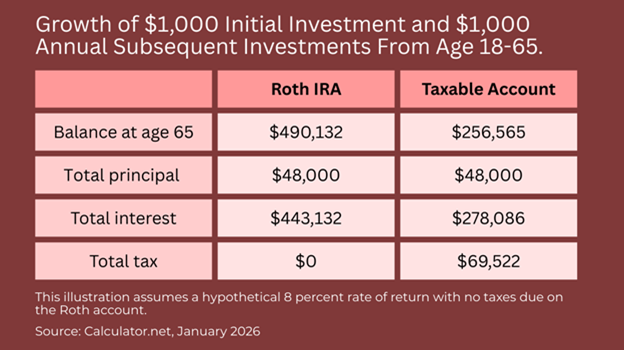
If your child doesn’t think they can put away $1,000 a year, remind them that skipping the daily Frappuccino might save them more than that amount!
Revisiting your child’s portfolio once a year can reinforce these lessons. Periodic reviews create familiarity with market movements and can help show the effects of market volatility. Over time, children learn that investing is not about constant activity, but about patience, ownership, and long-term thinking.
Setting Up the Next Generation
As financial professionals, we often help our clients get the next generation off to the right start in their investment journey. Contact us to learn how we can help your family build a lasting legacy.
We will continue the theme of teaching financial literacy to young adults later this month with more practical examples!