



Whole life insurance is often sold as a product that can do two jobs at once: provide life insurance protection while also building cash value over time. On the surface, that sounds efficient. But combining two jobs into one product does not automatically make the product better.
Before evaluating life insurance as an investment, we believe it should first be evaluated simply as insurance. The correct starting questions should be simple:
- How much protection does my family need?
- How long do I need that protection?
- What would happen financially if I were no longer here?
Once those questions are answered, it becomes easier to evaluate whether a more complex product, such as whole life insurance, is the right tool for the job. When one product tries to solve both an insurance need and an investment goal, the tradeoffs often become much harder to see.
Start With the Insurance Need
When looking at term vs. whole life insurance, it helps to step back and ask what problem life insurance is actually meant to solve.
For many families, life insurance exists because someone depends on your income. It may be needed to help replace lost earnings, pay off a mortgage, fund college expenses, or provide financial stability during a difficult time—needs that are often highest when families are young and responsibilities are greatest.
A young family with children, a mortgage, and many working years ahead of them may need a large amount of coverage. Over time, that need often declines as debts are reduced, children become financially independent, and retirement assets grow.
Term life insurance is specifically designed for this situation: providing a large amount of protection for a defined period at a relatively low cost.
Whole life insurance works differently. It is designed to provide permanent coverage and includes a cash-value component, which adds significant cost and complexity.
Same Death Benefit, Very Different Cost
Consider a healthy 30-year-old male evaluating $1,000,000 of life insurance coverage. Based on published rate estimates from Ethos and Ramsey Solutions, a traditional whole life policy will cost approximately $888 per month. Meanwhile, a 30-year term policy with the exact same $1,000,000 death benefit would cost approximately $64 per month.
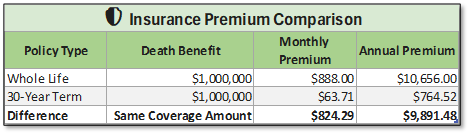
In this example, both policies provide a $1,000,000 death benefit during the 30-year term period—the years when life insurance coverage is often most critical.
What differs is the cost. Whole life provides coverage and cash-value features, while term provides protection only. That premium difference is where the real comparison begins.
The Opportunity Cost: Buy Term and Invest the Difference
When people evaluate the cost of whole life insurance, the discussion often centers on the cash value. But the more important question is what those same dollars could do if used differently.
Using the same example above, the term policy costs roughly $9,900 less per year than the whole life policy. That massive difference could be used to build emergency reserves, pay down debt, fund retirement accounts, save for college, or invest for long-term growth.
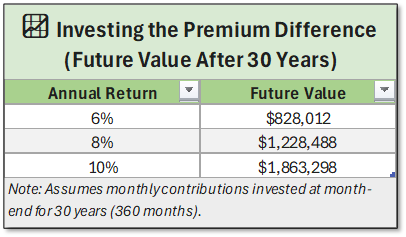
If the monthly premium difference—approximately $824—were invested for 30 years, the ending value would depend on the rate of return earned. Different hypothetical return assumptions produce outcomes ranging from roughly $800,000 to more than $1,800,000.
The chart below illustrates how that premium difference compounds over time under different return assumptions.
There is another practical consequence of higher premiums that often gets overlooked. When insurance costs more, families may end up buying less coverage than they actually need. The result can be a more complex insurance product paired with a smaller death benefit during the years when income replacement is highest.
This does not prove that term insurance is always better, but it does force a fair comparison. Is the cash value inside a whole life policy worth the significantly higher premium compared to the strategy of buying term and investing the difference?
For many families, that is a difficult hurdle for whole life to clear.
Keep the Jobs Separate
At THOR Wealth Management, we generally prefer to keep insurance and investing separate unless there is a clear planning reason to combine them.
Insurance should be evaluated based on coverage need, death benefit, policy length, guarantees, and beneficiary protection. Investments should be evaluated based on expected returns, risks, costs, liquidity, tax treatment, and how they fit into an overall financial plan.
When one product tries to do both, it can become harder to evaluate objectively. The insurance wrapper can make the investment sound safer, while the investment component can make the insurance sound more attractive. But complexity does not automatically mean better.
A simple strategy often works well: buy the amount of insurance protection you need, keep the cost reasonable, and invest the difference intentionally.
When Whole Life May Make Sense
Permanent insurance may make sense when there is a permanent planning need, such as certain estate planning strategies, business succession planning, special needs planning, or high‑net‑worth situations where other savings vehicles are already maximized.
The key is that whole life should be purchased because it solves a specific planning problem—not simply because it was presented as a better investment. The question is not whether whole life can work, but whether it is the best tool for the job.
Let the Plan Choose the Product
Life insurance is an important part of a financial plan, but the product should come after the planning need is understood.
- How much coverage is needed?
- How long is it needed?
- Who depends on the income?
- What debts would need to be covered?
- What assets already exist?
- How much premium can reasonably be afforded?
- What else could be done with that cash flow?
For many families, the answer may be straightforward: buy enough affordable protection with term insurance, then use the remaining cash flow intentionally—whether that means investing, building reserves, paying down debt, or funding other goals. Whole life insurance can make sense when it solves a specific planning problem, but it should earn its place in the plan.
Insurance should protect the plan. It does not need to always be the plan.