


Ten years ago, I was on a golf trip in Arizona and made a bet with a friend. We were arguing about Apple versus Google. Aside from the pure sport of debating frivolous things, my position also stemmed from the fact that I didn’t have an iPhone. I felt the need to defend myself (and my green text bubbles).
This led to a 10-year bet on which stock would outperform. The loser would have to buy season tickets for the Cincinnati Reds, which was later amended to single-game Diamond seats as cooler heads prevailed.
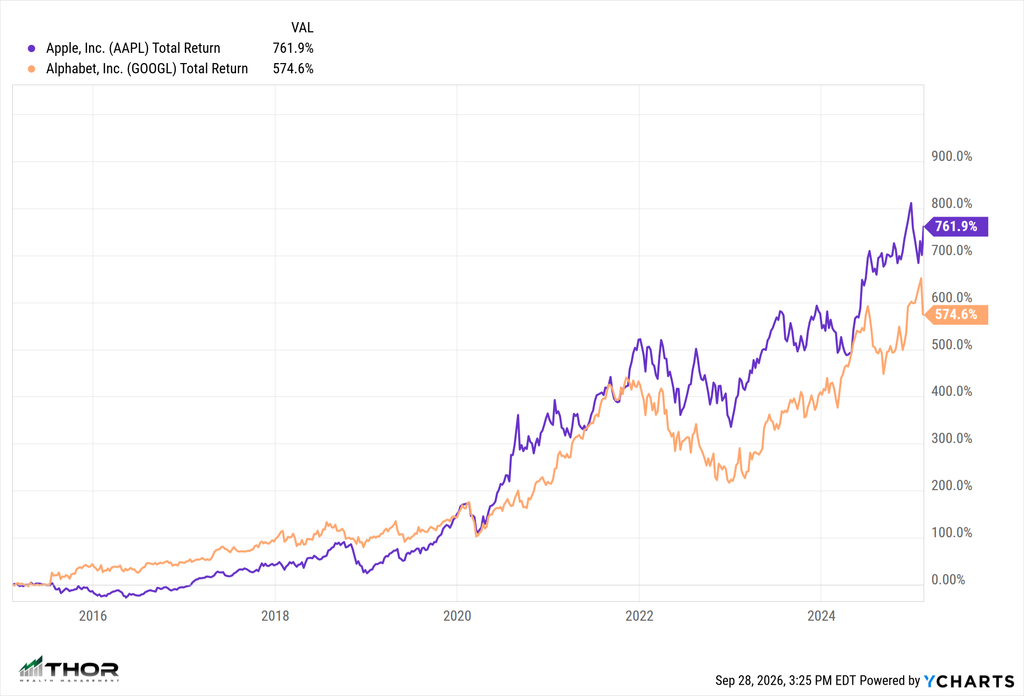
As you can see from the chart above, I lost the bet.
I am not here to talk about technology or software versus hardware, but rather to highlight the important fact of why a bet is fundamentally different from an investment.
The Crucial Difference Between Gambling and Investing
When gambling, you can’t be wrong and make money. If you bet on Joe Burrow to have 300 passing yards and he throws for 295, you are wrong and your money is gone. But with an investment, you can be wrong and still make money. For example, if you bought Nvidia five years ago as a play on cryptocurrencies, your thesis was wrong—much of that specific technology demand was discontinued. But because AI boomed beyond what you could have imagined, you were wrong and still made a killing.
Market Liquidity and the Power of Optionality
Another difference is that with an investment, if you change your opinion, you have the ability to act on it. A few years into our bet, I finally got an iPhone. Not only did I convert to a blue bubble, but I recognized the durable nature of Apple’s quality and brand. I knew I had been wrong about Apple. But here, there was nothing to do; my fate was out of my hands. I just had to hope Google did better. If it had been an investment, I would have had the option to exercise that change of opinion. Because there is a deep, liquid market, I could have exited my position, trimmed it, or bought another asset entirely.
Why Intellectual Honesty is an Investing Superpower
These are not only structural differences, but opportunities for investors. If you embrace the idea that you can and will be wrong—but that you can still make money—that is empowering. It encourages investing while at same time builds a healthy respect for risk and promotes concepts like discipline and diversification. Personally, thinking about investment decisions as a mosaic has vastly improved my investing.
Since the markets give you the optionality to change your mind, they favor those who are intellectually flexible and honest. One of the hardest things to do is to say “I was wrong” and change your opinion. As investors, we frequently fall victim to the Endowment Effect—a behavioral bias where we place a higher value on an asset or a belief simply because we already own it. Recognizing and overcoming that bias is a superpower in investing. With hundreds of thousands of daily liquid investments, there is no reason to get emotional about a single ticker.
A Generalist Approach to Portfolio Management
At THOR, we are generalists on the investment committee. Not only among sectors of the market, but also across asset and style classes. I am grateful for this approach because we are given the chance to research all different types of companies and strategies. We also can actively adapt and take advantage of opportunities. We don’t make 10-year, set-it-and-forget-it wagers. In investing, you live and learn—but thankfully, the market lets you change your mind before you have to pay up.